News reported in late Jun, NDRC, MOFCOM released ‘Catalogue for the Guidance of Foreign Investment Industries (Amended in 2017)’, and will start implement on Jul 28, 2017.
Among, contents below are related to LIB industry chain and listed in ‘Encouraged’:
ü New energy vehicle key parts manufacture: LIB separator (thickness 15-40μm, porosity 40~60%); battery management system, electric engine management system and EV electronic control integration etc.
ü High technology green battery manufacture: Power nickel-metal hybrid battery, zinc-nickel storage battery, zinc-silver storage battery, lithium ion battery, solar cell, fuel cell etc. (new energy vehicle energy power battery excluded).
ü Waste battery recycling treatment.
ü Construction and operation of automotive electric charging station, battery change station.
ü Comprehensive utilize concentrated sea salt production; K, Br, Mg, Li extraction and their deep processing etc. sea water chemical resource high added value utilization technology.
Contents below are related to LIB industry chain and listed in ‘Limitation’
ü Graphite exploration and exploitation.
ü Vehicle whole car, special use vehicle manufacture: Chinese party share’s proportion no lower than 50%, same foreign mechanics can establish 2 and less JV enterprises to produce same type (passenger use vehicle, commercial use vehicle) in China. If joint merge China other vehicle production enterprises with China JV partner and establish JV enterprise which produces pure EV whole car production cannot limit by 2.
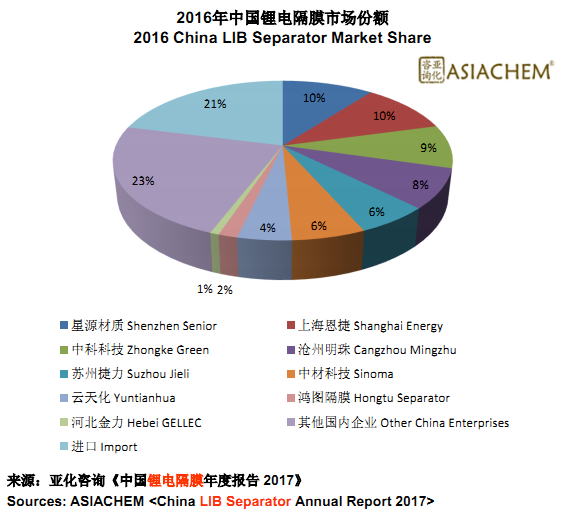
ASIACHEM information shows that, in 2016, China LIB separator consumption was 1.372bnm2, among, domestic separator 1.084bnm2, imported separator 288Mm2, localization rate is almost 80%. Although part of China separator enterprises realizes large batch export; domestic separators performance steadily improve and gain domestic battery enterprises’ recognition and localization rate is further increasing, China market structure low-end and mid, high-end polarization is serious. Low-end products excess capacity. In high-end separator field, however, most China independent brand enterprises are still at disadvantage in competing with foreign separator enterprises. Some power batteries use mid and high-end separator markets still seriously rely on import.
On LIB aspect, in 2016, China LIB output is 68.6GWh and estimated China LIB output will reach 79.3GWh in 2017.
Although new energy vehicle energy power battery is excluded from 2017 ‘Catalogue for the Guidance of Foreign Investment Industries’ ‘Encouraged’, currently, there still are many foreign LIB giants layout power LIB capacity in China as they are optimistic about China power LIB market and future subsidy policy changes.
In Apr 2017, Dalian Panasonic Vehicle Power Battery Project Phase-1 put into operation. The project contract was signed in 2015, and project construction was promoted by Dalian Panasonic Vehicle Energy Co. Ltd., joint founded by Panasonic Corporation of China and Dalian Levear Electrical Appliance. The project locates in Dalian Free Trade Zone Vehicle Industry Park Area and construction by 2 phases. Among, Phase-1 total investment exceeded CNY 2bn, covers an area of 170knm2, mainly engages in design, manufacture, sales and after sale service of vehicle use LIB etc.; Phase-2 project is estimated to start construction in 2017.
Except Panasonic, LG Chem, Samsung SDI and South Korea SKI also set up battery plants in China. Among, LG Chem stated that it in China’s factory capacity utilization rate increases in Q1 and planed to expand its Nanjing factory; Samsung SDI will continue adding factories as planned, in May, the company Q1 report shows that the company has founded battery production cooperative artificial person in Wuxi, China in Jan 12, and Samsung SDI holds 50% share; South Korea SKI, however, stated that its new energy vehicle battery plant which was JV and founded in China currently has ceased production.
Speaking from battery production engineering, on battery manufacture device level, management ability, process control ability etc. aspects, these Japanese and South Korean enterprises are better than China enterprises. Base on these Japanese and South Korean enterprises’ technology level and manufacture process, it is not hard for their power battery products to pass new GB/T.
ASIACHEM believes that, release and implement of ‘Catalogue for the Guidance of Foreign Investment Industries (Amended in 2017)’ and ‘Vehicle Power Battery Industry Normality Condition (2017) (Exposure Draft)’ released by MIIT in Nov 2016 will make power battery industry and its industry chain enterprises’ competition intensify. Large enterprises should continue strengthening their products’ R&D and technology’s increase and whole industry chain’s layout to keep their products’ core competiveness. Some small enterprises, however, will be merged or be eliminated. Industry integration has become a big trend of industry development.


